Email Parser extracts data from your emails automatically
It reads incoming emails and captures the information you need, using AI or simple rules. The captured text can be sent to spreadsheets, APIs, or databases. It also handles attachments and sending replies.
Use this AI email parser to automatically extract data from emails and automate your workflows. No manual data entry required.
What is an email parser?
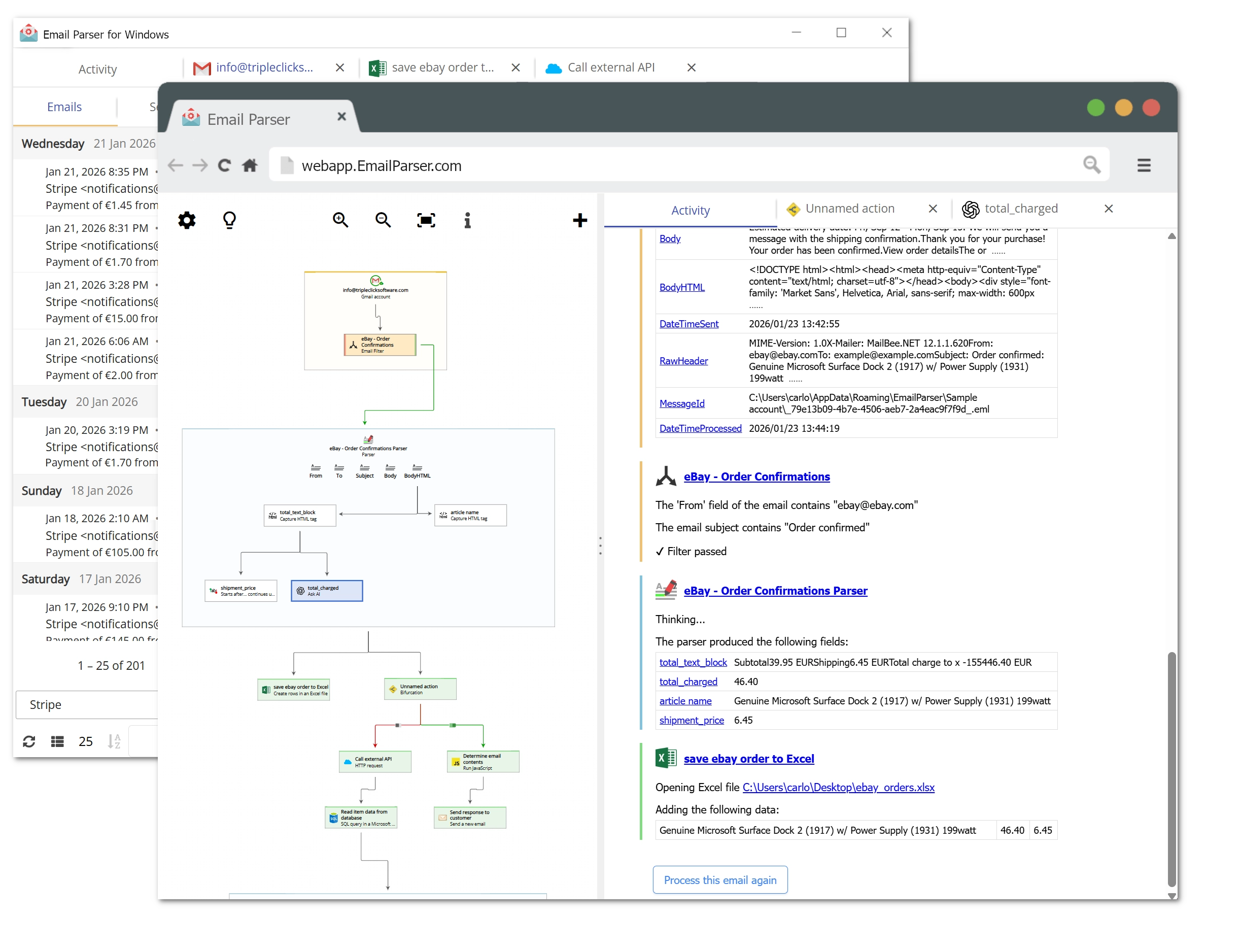
An email parser reads the emails you receive and picks out the pieces of information you care about: an order number, a customer’s name, an amount, a tracking code, a date. Then it puts that information where you need it, so nobody has to copy and paste it by hand.
A typical case: a shop gets 50 order notifications a day and someone types each order into a spreadsheet. With Email Parser, every new notification becomes a new row in Excel or Google Sheets a few seconds after it arrives. The same works for invoices attached as PDF files, leads from a web form, booking confirmations, alerts from monitoring systems or any email that follows a repeated format. Read more about email parsing.
How it works
1. Connect your mailbox
Add a Gmail, Office 365, Exchange, IMAP or POP account. In the Web App you can also use a ready-made @inbox.emailparser.com address and forward emails to it.
2. Tell it what to capture
Ask in plain words, for example “What is the order total?”, and the AI finds it. If you need exact, predictable results, use rules instead, such as “starts after… continues until…” or regular expressions.
3. Decide what happens next
Add a row to Excel or Google Sheets, insert it into SQL Server or MySQL, call your API, save the attachments or forward the email. From then on, it happens for every new email.
Automated Email Parsing and Data Extraction
Email Parser continuously monitors your inbox, watching for new incoming emails across one or multiple accounts.
Each arriving email triggers a workflow that performs multiple actions automatically: text capturing from the email, appending rows to spreadsheets, updating databases, communicating with REST APIs, or executing custom logic through JavaScript and C# scripts. You can even call external applications to integrate email data with your existing tools and systems.
This automation turns incoming emails into triggers that execute business processes, update data, and integrate with other systems without requiring manual intervention.
AI-Powered Email Data Capture
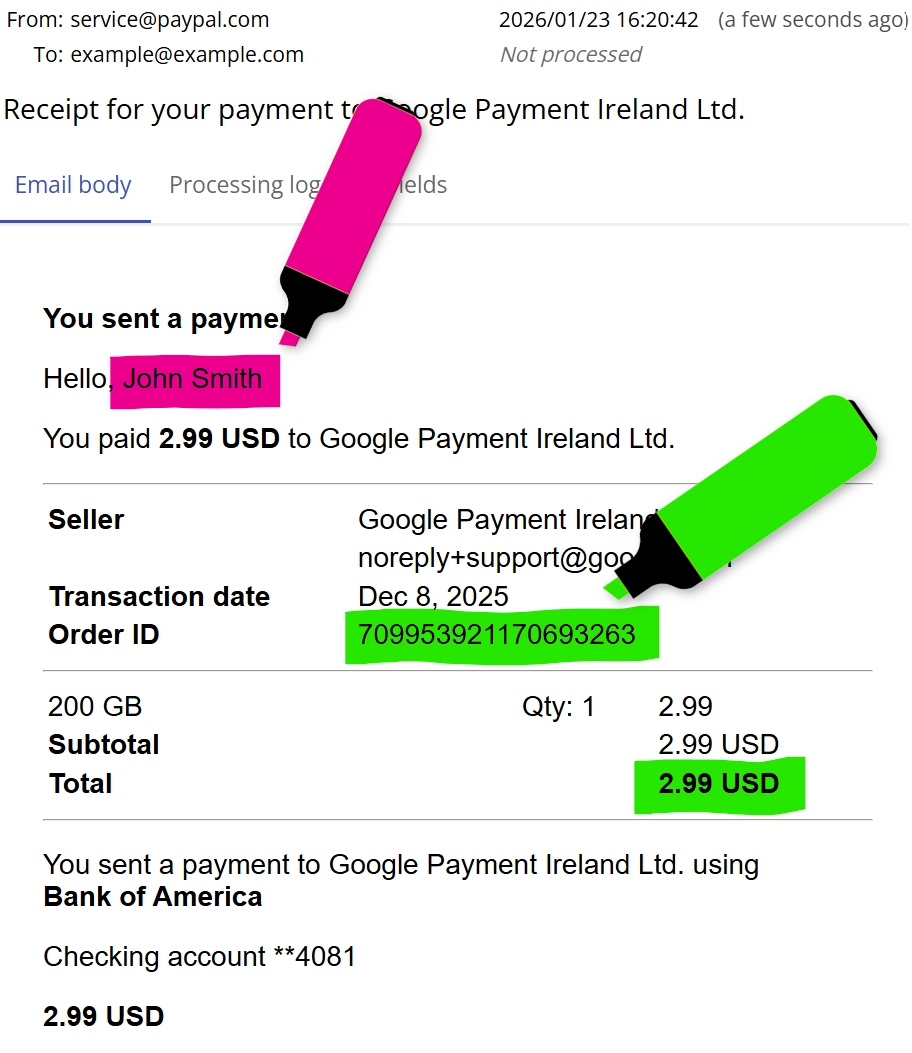
Email Parser features AI-powered text extraction (powered by OpenAI GPT models) that lets you ask questions in natural language, such as “what is the name of the seller that appears on this email?” or “what is the order total?”, and you will automatically receive the extracted information.
For workflows that require precise, rule-based extraction, Email Parser also supports traditional approaches ranging from simple to advanced. Basic needs are covered by defining text boundaries (specifying what the content looks like or where it appears in the email). Advanced users can leverage regular expressions for complex pattern matching or write custom scripts for specialized extraction logic.
Beyond email body text, Email Parser also processes data from attached documents, supporting a wide range of formats including PDF, Excel, and XML files.
Parse Email Data from Existing Messages
Email Parser can process emails that are already in your inbox, not just new incoming messages. You can browse through your existing emails and trigger processing on demand for specific messages or groups of emails.
Once properly configured, Email Parser can convert any email into structured data. The most common outputs are spreadsheets like Google Sheets, CSV, or Excel, and databases like MySQL and SQL Server.
Email Parser can be heavily customized to support virtually any format or integration through JavaScript, C# scripts, or REST API calls.
Why people choose Email Parser
Your emails stay on your computer
The Windows App stores everything locally and never calls home. It only connects to the mail servers, databases and services you set up yourself. You can check this with a network monitor such as Wireshark.
One yearly price, no per-email credits
The Windows App processes an unlimited number of emails from an unlimited number of accounts for one yearly subscription. Many cloud parsing services charge per email or per document instead.
AI when it helps, rules when you need precision
Use AI for emails that change from one sender to another, and exact rules for emails that always look the same. You can mix both in the same workflow.
Works with the tools you already use
Excel, Google Sheets, CSV files, SQL Server, MySQL, ODBC databases, REST APIs, Zapier and IFTTT. When something isn’t covered, you can run your own C#, JavaScript or PowerShell scripts, or call any program.
Runs unattended
Leave it running on a PC, as a Windows service, or on a small cloud server. It needs very little: 2 GB of RAM is enough. Or use the Web App and run nothing at all.
Built by the same small team since 2008
Email Parser is made by Triple Click Software, and our customers are in more than 40 countries. Upgrades are free, and when you write to support, the people who answer are the people who build it.
Email Parser works with
Read emails from Gmail, Outlook / Office 365, Exchange or any IMAP or POP mailbox, and send what you capture to Microsoft Excel, Google Sheets, CSV files, SQL Server, MySQL, REST APIs and webhooks, Zapier or IFTTT.
See how to…
- How to parse emails with AI using natural language prompts
- How to extract invoice and order data from emails automatically with AI
- How to export Emails to Google Sheets
- How to export Outlook emails to Excel
- How to filter incoming emails, parse data and write to Excel file
- How to parse Amazon dispatch notifications
- How to parse emails with the Web App
- How to parse an attached PDF file
- How to use regular expressions to parse email data
- How to use AI to capture data from emails without coding or regular expressions
- How to parse a table in an email and export to Google Sheets
- How to save attachments automatically from an incoming email
- How to set conditions and run actions based on them
- How to store an email attachment in a MySQL database
- How to install and uninstall the Email Parser Windows App
- How to forward emails based on filter rules
- How to capture data from an attached CSV file and save it to a database
Windows App or Web App?
Both work the same way and both come with a 30-day free trial. They are sold separately.
| Windows App | Web App | |
|---|---|---|
| Price after the trial | $145 / €145 per year | $25 / €25 per month, or $249 / €249 per year |
| Emails processed | Unlimited | Up to 5,000 per month |
| Email accounts | Unlimited | Up to 10 |
| AI capture | Unlimited, with your own OpenAI API key | 500 AI captures per month included (unlimited with your own key) |
| Where it runs | Your Windows 10/11 PC or Windows Server | In the cloud, nothing to install |
| Files, scripts and local programs | Yes: local Excel/CSV files, C#, PowerShell, external programs | JavaScript and AWS Lambda only |
| Best for | Privacy, high volumes, working with files on your network | No computer to keep running |
Frequently asked questions
What is an email parser?
A program that reads incoming emails and extracts specific information from them, such as order numbers, names, amounts or dates, so you don’t have to copy it by hand. Email Parser then sends that information wherever you need it: a spreadsheet, a database, an API or another email.
Is there a free trial?
Yes. Both the Windows App and the Web App can be used free for 30 days. After that, the Windows App costs $145 / €145 per year and the Web App $25 / €25 per month or $249 / €249 per year. There are no setup fees, and the Web App can be cancelled at any time.
Can it export emails to Excel automatically?
Yes. Every new email can add a row to an Excel file, a Google Sheet or a CSV file. You choose which values go into which columns. See how to export Outlook emails to Excel.
Does it work with Gmail and Office 365?
Yes. It works with Gmail, Office 365 (Outlook), Exchange and any IMAP or POP mailbox. The Windows App can also read .eml and .msg files from a folder, and the Web App includes its own mailbox you can forward emails to.
Do I need to know how to code?
No. You can describe what to capture in plain words and let the AI find it, or point at the text with simple rules such as “starts after… continues until…”. Scripting in C#, JavaScript or PowerShell is there if you want it, but most workflows don’t need it.
Does my data leave my computer?
With the Windows App, no. Emails, settings and logs are stored only on your computer, and the app never sends data to us. It only connects to the services you configure: your mail server, databases, spreadsheets or APIs. One exception to keep in mind: if you use AI capture, the text you ask about is sent to OpenAI using your own API key. Details are in the Windows App privacy policy.
Do I need an OpenAI account to use the AI features?
In the Web App, no: 500 AI captures per month are included, and you can add your own OpenAI API key to remove that limit. The Windows App always uses your own OpenAI API key, and we don’t put any limit on how much you use it. See how AI credits work.
Can it read PDF and other attachments?
Yes. The text of attached PDF, Word and text files is available to capture just like the email body, so you can pull an invoice number out of a PDF, for example. You can also save attachments to a folder automatically. See parsing text from attached files.
What do I need to run the Windows App?
Windows 10 or 11, or Windows Server 2019 or 2022, and very modest hardware: 2 GB of RAM and a single-core CPU are enough. One subscription covers up to 3 computers. See the system requirements.