Running Email Parser as a Windows Service
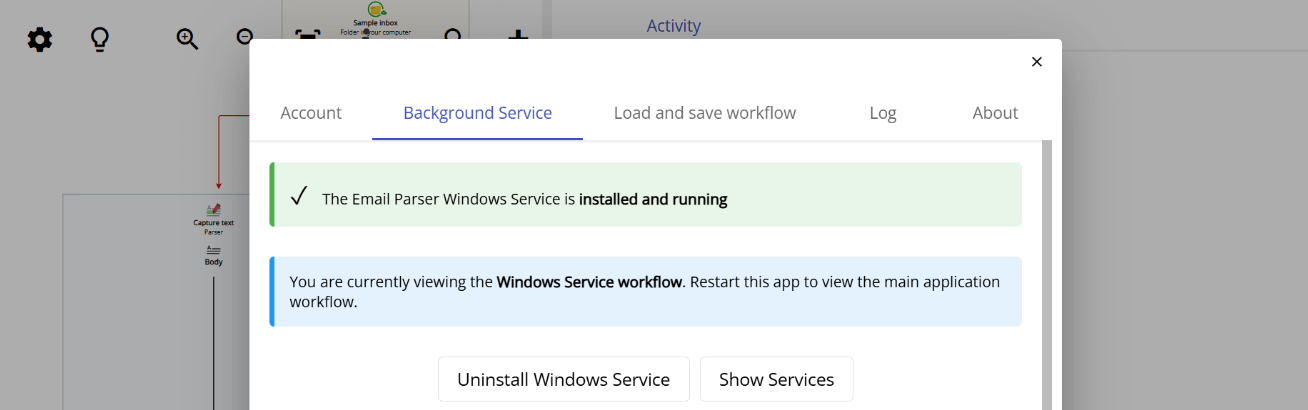
The Email Parser Windows Service processes your emails automatically in the background, even when the Email Parser application is closed. Once installed, the service starts automatically with Windows and runs continuously to check your email accounts and execute your workflow, without requiring the application to be open at all.
To activate the Windows Service, click the gear icon at the top left of the Email Parser application to open the settings window, then go to the “Background Service” tab and click the “Install Windows Service” button.
Choosing which workflow to edit on startup
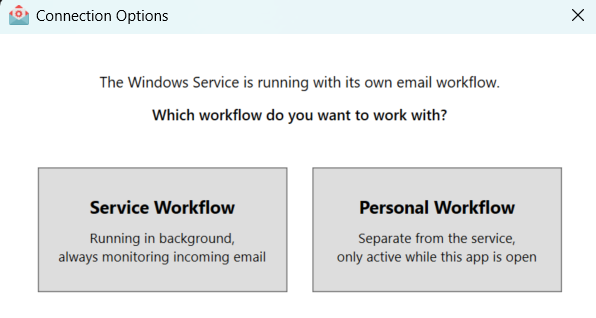
When you open the Email Parser application and it detects that the Windows Service is already running in the background, it will show you a dialog asking which workflow you want to work with. You can choose to view and edit the Windows Service workflow, or open your regular application workflow instead. This prompt only appears when the service is active, so if the service is not running, the application will open your regular workflow directly.
Independent workflow configuration
The Windows Service maintains its own independent workflow configuration, which includes its own set of email accounts, filters, parsers, fields, and actions. This separation ensures that the service’s automated background processing does not interfere with workflows you are actively testing or developing in the main application.
Think of it this way: the service has its own “copy” of the workflow that runs on its own, while you can freely experiment and make changes in the application without affecting what the service is doing. This is particularly useful if you want to test a new parser or action without disrupting ongoing email processing.
Verifying the service is running
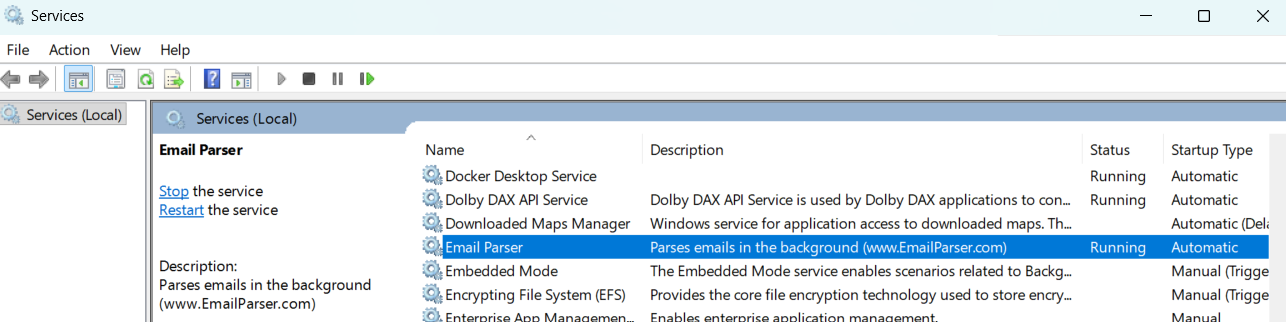
You can confirm that the Email Parser Windows Service is active at any time by opening the Windows Services tool. To do this, type “Services” in the Windows Start menu and press Enter. Look for “Email Parser” in the list. If the service is running, its status will show as “Running.”
Transferring your workflow configuration
Since the service and the application each have their own independent workflow, you may need to transfer settings between them. For example, you might want to copy the workflow you have been building in the application over to the service so it can run automatically in the background.
To do this, use the “Load and save workflow” tab. This feature allows you to export your current workflow to a file and then import it into the service, or load the service’s workflow into the main application for editing. It works in both directions, so you have full control over which configuration is active in each environment.